Voice evacuation system: fire alarm term explained
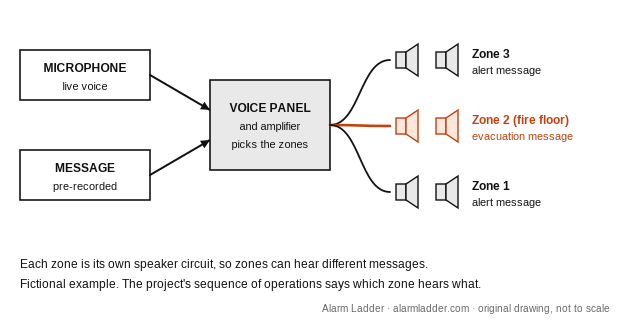
A voice evacuation system is a fire alarm system that uses speakers to give spoken instructions instead of only tones. On alarm, the voice panel plays a pre-recorded message to the affected zones, and a microphone lets responders give live directions. Multi-zone systems can send different messages to different parts of a building.
Use this diagram
How a voice system works and what changes for the technician
- Two message sources. A message generator holds the recorded messages the system plays on its own. A microphone at the panel lets a responder take over and speak to the building. Both feed the same amplifiers.
- Amplifiers and speaker circuits. The amplifier drives speaker circuits with audio, not the steady DC a horn and strobe circuit carries. Do not run a horn/strobe DC voltage drop calculation on a speaker circuit; follow the amplifier and speaker instructions instead. To check a speaker circuit's line loss and amplifier load, use the speaker circuit calculator.
- Zones. Speakers are grouped into zones, each on its own circuit, so the panel can choose who hears what. In a multi-zone system the fire floor can hear an evacuation message while other floors hear an alert, as the project's sequence of operations sets out.
- Tones still matter. Speakers can sound the temporal-3 evacuation pattern as well as speak, so a voice system is still checked for the right signal pattern, not only the words.
- Wiring that has to last. A circuit carrying instructions to people still in the building has to keep working during the fire, so speaker circuits often need a protected pathway.
- Batteries carry a longer alarm. A voice system's batteries have to run the alarm load for longer than an ordinary horn system's. Take the duration from the battery calculation method and the edition the job enforces.
Try one question
Question 1 of the free 10-question check on NICET FA IV. No signup. About 14 minutes. Most checks include 2 calculation questions, with a calculator on the page. Then ask Strobe, the AI study assistant, why the answer is right and the others are wrong.
Complex Fire Alarm System Operations
Voice messages in a glass-walled atrium are loud but hard to understand. What design change is most likely to help?
Press A-D or 1-4 to choose an answer while this question is on screen.
Choose an answer to begin
Worked example: one fire, three zones
A fictional three-story clinic has one speaker zone per floor. A smoke detector on the second floor goes into alarm. The sequence of operations says the second floor hears the evacuation message and the first and third floors hear an alert message. The technician confirms each zone plays the right message and that the strobes flash where the drawings show. Then they pick up the microphone, select the third floor only and speak a test announcement, and confirm it comes through clearly on that floor and nowhere else. A zone that plays the wrong message is a programming or wiring fault to fix before acceptance, even if every speaker is loud enough.
Common mix-ups
- Loud is not the same as clear. A tone works once it is heard. A spoken message only works if people can make out the words, so listen for clarity, not just level.
- A speaker circuit is not a NAC with different appliances. It carries amplifier audio, so the horn/strobe current and voltage methods do not transfer.
- Multi-zone is not every zone at once. The point of zones is that different parts of the building can be told different things.
- The battery sheet changes. Using an ordinary system's alarm duration on a voice system leaves the battery too small.
Voice evacuation on the NICET Level IV exam
NICET's Level IV outline names multi-zone voice evacuation systems among the complex systems in its largest domain, complex fire alarm system operations, at 40 to 50% of the exam. That domain includes resolving complex notification scenarios (4.3.2), so expect to reason about zones, messages, pathways and power together. NFPA 72 (2022) Chapter 10 covers power supplies, Chapter 12 covers circuits and pathways and Chapter 18 covers notification appliances.
Practice it
Size the batteries in the fire alarm battery calculator, and enter the alarm duration your sizing sheet calls for. Read pathway survivability for why speaker circuits need protection, and the temporal-3 pattern for the tone speakers still sound. See how zones and messages are set in the sequence of operations, and find the rest in the fire alarm terms glossary.
Know your voice systems? Check the rest of Level IV
Take the free 10-question check. It is written to NICET's Level IV outline, needs no signup and explains every answer, so you see which of the three domains to work on first.
Ask Strobe: Am I ready?
Ask Strobe before you buy AI your AI study assistant
See what's on the NICET FA IV exam, test yourself with 5 quick questions, or find the plan that fits you.
The NICET FA IV course
Available now · instant accessLearn every Level IV task, from commissioning and budgets to complex detection and voice systems, then prove it on timed practice exams.
Instant access. Terms and refunds · Secure checkout by Stripe · Billed by Nori Software
What's inside
- 10modules of lessonsEvery task on the outline
- 2full-length timed exams120 questions in 290 minutes each
- 351practice questionsEach one explained
- 6worked calculationsStep by step
- 17code-navigation drillsFind it fast in NFPA 72
- 1week-by-week study planSet to your exam date
Turn a practice answer into a study step. In untimed practice, ask Strobe AI about any question you answer, follow up, then see your weakest topics and what to drill next.
Every answer comes with a full explanation.
Sources
Show the list
- Fire Alarm Systems Level IV content outline, NICET, task 4.3.2, domain weights and the complex systems note. Checked 15 Nov 2026.
- NFPA 72 (2022), NFPA, Chapters 10, 12 and 18, referenced by number only. Checked 15 Nov 2026.
Alarm Ladder editorial team
Facts come from the sources listed above. If something has changed, tell us and we will correct it.
Your next step
Ready to see where you stand on NICET FA IV?
Free, untimed and scored by domain. No signup. About 14 minutes. Most checks include 2 calculation questions, with a calculator on the page.
Free 10-question checkLevel IV course. Lessons, timed practice exams and a plan around your exam date.
Get Level IV course · $199Want a timed run? Take the free 25-question practice test (about 60 minutes). No email needed.
Prefer paper? Free printables
- Print a class quiz (free PDF). 10 practice questions with an answer key on page 2.
- Print the flashcards as cut-out cards (free PDF). The free flashcard sample, ready to cut and carry.