Heat detector: fire alarm term explained
A heat detector reports a fire when the air around it gets hot, not when it sees smoke. A fixed-temperature type alarms when it reaches a set temperature. A rate-of-rise type alarms when the temperature climbs quickly. Many units combine both, so one device answers a slow rise and a fast one.
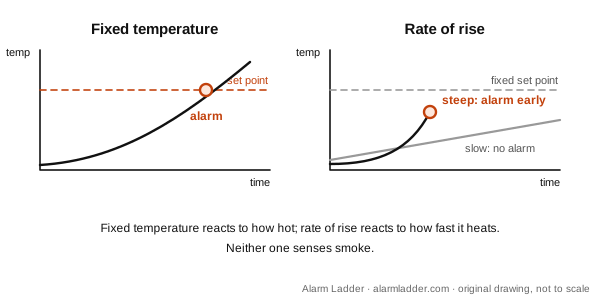
How to tell the two types apart
- Fixed temperature. The device has a set temperature, usually printed on it. When the air at the device reaches that temperature, it signals alarm. A slow, steady warm-up still ends in an alarm once the set point is reached.
- Rate of rise. The device compares how fast the temperature is climbing against a limit. A fast climb alarms it even though the air is still below any fixed set point, and a slow climb does not.
- Combination units. Many heat detectors have both elements in one housing. The rate-of-rise element gives early response to fast fires, and the fixed element catches slow ones that the rate element would ignore.
- Restorable or not. Some fixed elements reset when they cool and others are one-time. The data sheet says which, and a one-time element has to be replaced after it operates.
Try one question
Question 1 of the free 10-question check on NICET FA I. No signup. Then ask Strobe, the AI study buddy, why the answer is right and the others are wrong.
Installation
A supplied module drawing labels COM, NO and NC. The door interface needs a switched contact that is open while the relay is at rest and closes when the relay operates. Which pair matches that instruction?
Press A–D or 1–4 to choose an answer while this question is on screen.
Choose an answer to begin
Worked example: why it is in the garage
A fictional parking garage has exhaust fumes and dust that would trip smoke detectors every day. The designer specifies heat detectors there. A technician later finds one painted over by a maintenance crew. Paint can insulate the element and slow its response, so the device is replaced rather than cleaned, and the finding is recorded. The same reasoning explains why a heat detector never takes the place of smoke detection in an area where early warning is the goal.
Ask Strobe before you buy AI your Alarm Ladder study buddy
See what's on the NICET FA I exam, test yourself with 5 quick questions, or find the plan that fits you.
The NICET FA I course
Available now · instant accessLearn every Level I task, then prove it on timed practice exams.
- 6modules of lessonsEvery task on the outline
- 2full-length timed exams85 questions in 110 minutes each
- 340practice questionsEach one explained
- 4worked calculationsStep by step
- 20code-navigation drillsFind it fast in NFPA 72
- 1week-by-week study planSet to your exam date
Turn a practice answer into a study step. In untimed practice, ask Strobe AI about any question you answer, follow up, then see your weakest topics and what to drill next.
Instant access. Terms and refunds · Secure checkout by Stripe
- Level I, II and I&T bundle$299$98 less than buying the 3 courses separatelyIncludes the NICET FA I, NICET FA II and NICET I&T FA courses
Terms and refunds · Secure checkout by Stripe
- Free sample lessonFree
- Question of the dayFree
Every answer comes with a full explanation.
Common mix-ups
- Heat detectors do not sense smoke. They are slower than smoke detectors for most fires, so they are used where smoke detection would be unreliable, not as a cheaper substitute.
- Set point is not room temperature. A fixed-temperature device is selected for a space, so a hot boiler room needs a higher set point than a corridor. Use the rating the drawings call for.
- Rate of rise can alarm in normal heat swings. A blast from a heater or an oven door opening can produce a fast change. Placement away from such sources is a design question.
- Spacing comes from the listing. How far apart heat detectors can be is listed by the manufacturer and tied to NFPA 72, so it is not a rule of thumb.
Heat detectors on the NICET Level I exam
Heat detectors appear whenever a scenario asks which device fits a hazardous or dusty space, and in Maintenance (40 to 50% of Level I) when testing and replacement come up. Installation covers 44 to 54% of the exam, which includes terminating and mounting the device. NFPA 72 (2022) Chapter 17 covers initiating devices and Chapter 14 covers testing.
Practice it
Find heat device symbols among the others in the fire alarm symbols quiz. Then compare with photoelectric and ionization smoke detectors, a duct smoke detector and a manual pull station. The full list is in the fire alarm terms glossary.
Know your devices? Check the rest of Level I
Take the free 10-question check. It's weighted to the Level I outline, scored by domain and needs no signup, so you see whether installation, maintenance or layout costs you the most points. The Level I course gives you full timed practice exams, an explained answer for every question and the section number to look up for each one.
Sources
Show the list
- NFPA 72 (2022), NFPA, Chapters 14 and 17, referenced by number only.
- Fire Alarm Systems Level I content outline, NICET.
Facts checked 25 October 2026 against the sources listed above. If something has changed, tell us and we will correct it within 2 business days.
Your next step
Ready to see where you stand on NICET FA I?
Free, untimed and scored by domain. No signup.
Start the free 10-question checkLevel I course. Lessons, timed practice exams and a plan around your exam date. Get Level I course · $99 See the plans or read the free sample lesson.Terms and refunds
Want a timed run? Try the free 25-question mini-mock. The first 5 need no email.