Acknowledge, silence and reset: fire alarm term explained
Acknowledge, silence and reset are three different panel actions. Acknowledge tells the panel you have seen the event and quiets its buzzer. Silence turns off the horns and strobes. Reset returns the system to normal after the cause is cleared. None of them fixes the problem, and reset only works once the cause is gone.
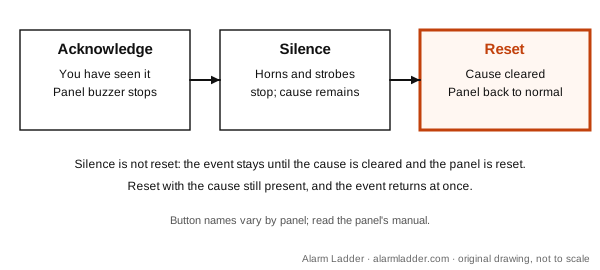
What each action does and when to use it
- Acknowledge. Pressing it tells the panel a person has seen the new event. The panel's own buzzer stops, and the event is marked as seen. The condition and the outputs are not changed.
- Silence. This turns off the notification appliances. The alarm condition is still there, the panel still shows it, and the system may return to alarm if a new alarm comes in. Some panels hold off silencing for a set time or require a code.
- Reset. After the cause is cleared, such as the pulled station reset or the smoke cleared, a reset returns latched events and outputs to normal. The panel rescans, and if the cause is still present the event comes right back.
- Do them in order. Acknowledge what you see, silence only when the building's procedure says it is time, then clear the cause and reset. Button names and the exact behavior vary by panel, so read the panel's manual.
Try one question
Question 1 of the free 10-question check on NICET FA I. No signup. Then ask Strobe, the AI study buddy, why the answer is right and the others are wrong.
Installation
A supplied module drawing labels COM, NO and NC. The door interface needs a switched contact that is open while the relay is at rest and closes when the relay operates. Which pair matches that instruction?
Press A–D or 1–4 to choose an answer while this question is on screen.
Choose an answer to begin
Worked example: why it re-alarmed
After a fictional alarm test, a tech silences the horns and presses reset. The panel goes back into alarm at once. The event text shows a smoke detector still in alarm, because smoke from the test has not cleared from its chamber. Waiting a minute and clearing the detector as the manufacturer allows lets the reset hold. The tech notes the lesson: reset checks whether the cause has cleared, and it will not hide one that has not.
Ask Strobe before you buy AI your Alarm Ladder study buddy
See what's on the NICET FA I exam, test yourself with 5 quick questions, or find the plan that fits you.
The NICET FA I course
Available now · instant accessLearn every Level I task, then prove it on timed practice exams.
- 6modules of lessonsEvery task on the outline
- 2full-length timed exams85 questions in 110 minutes each
- 340practice questionsEach one explained
- 4worked calculationsStep by step
- 20code-navigation drillsFind it fast in NFPA 72
- 1week-by-week study planSet to your exam date
Turn a practice answer into a study step. In untimed practice, ask Strobe AI about any question you answer, follow up, then see your weakest topics and what to drill next.
Instant access. Terms and refunds · Secure checkout by Stripe
- Level I, II and I&T bundle$299$98 less than buying the 3 courses separatelyIncludes the NICET FA I, NICET FA II and NICET I&T FA courses
Terms and refunds · Secure checkout by Stripe
- Free sample lessonFree
- Question of the dayFree
Every answer comes with a full explanation.
Common mix-ups
- Acknowledge is not silence. Acknowledge quiets the panel's own buzzer. Silence stops the horns and strobes in the building.
- Silence is not reset. A silenced alarm is still an alarm, and the panel still holds it.
- Reset does not fix the cause. It only clears events that no longer apply. See latching vs non-latching.
- Never reset to see what happens. Resetting during a real event can wipe the event history you need. Read and record it first.
Panel controls on the NICET Level I exam
Using the panel safely is part of Maintenance (40 to 50% of Level I), where you run tests and restore the system, and of Installation (44 to 54%), where commissioning ends with a normal panel. NFPA 72 (2022) Chapter 10 covers fundamentals including signals and Chapter 14 covers testing.
Practice it
Use the fire alarm symbols quiz for the devices that start events. Read about latching and non-latching signals and trouble signals, which behave differently on reset. See the fire alarm terms glossary.
Know your panel controls? Check the rest of Level I
Take the free 10-question check. It's weighted to the Level I outline, scored by domain and needs no signup, so you see whether installation, maintenance or layout costs you the most points. The Level I course gives you full timed practice exams, an explained answer for every question and the section number to look up for each one.
Sources
Show the list
- NFPA 72 (2022), NFPA, Chapters 10 and 14, referenced by number only.
- Fire Alarm Systems Level I content outline, NICET.
Facts checked 25 October 2026 against the sources listed above. If something has changed, tell us and we will correct it within 2 business days.
Your next step
Ready to see where you stand on NICET FA I?
Free, untimed and scored by domain. No signup.
Start the free 10-question checkLevel I course. Lessons, timed practice exams and a plan around your exam date. Get Level I course · $99 See the plans or read the free sample lesson.Terms and refunds
Want a timed run? Try the free 25-question mini-mock. The first 5 need no email.