Monitor module vs control module: fire alarm term explained
A monitor module is an input. It reads the state of a contact, such as a tamper switch, and reports it to the panel on its own address. A control module is an output. It does what the panel tells it, such as switching a fan relay or powering a notification circuit.
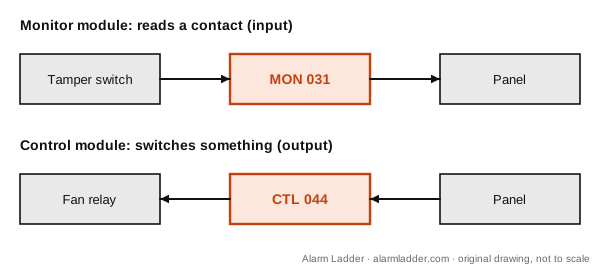
How to sort modules into inputs and outputs
- Ask which way the information goes. If the field device is telling the panel something, it is an input and uses a monitor module. If the panel is telling the field to do something, it is an output and uses a control module.
- Monitor module examples. A valve tamper switch, a waterflow switch or a contact from a non-addressable device. The module has an address and reports open, closed or trouble for that contact.
- Control module examples. A fan shutdown relay, a door-holder release, or an output that drives a notification appliance circuit. The panel energizes it as the sequence of operations requires.
- Both have addresses. Each module sits on the signaling line circuit with an address set on it, so the panel can name it. The wiring on the field side is separate from the loop, and its supervision depends on the module's design.
- Match the label to the job. Module types and labels vary by manufacturer, so the install manual shows which wiring a module expects.
Try one question
Question 1 of the free 10-question check on NICET FA I. No signup. Then ask Strobe, the AI study buddy, why the answer is right and the others are wrong.
Installation
A supplied module drawing labels COM, NO and NC. The door interface needs a switched contact that is open while the relay is at rest and closes when the relay operates. Which pair matches that instruction?
Press A–D or 1–4 to choose an answer while this question is on screen.
Choose an answer to begin
Worked example: one valve, one fan
A fictional riser has a valve tamper switch and the air handler has a fan that must stop on alarm. The tamper switch wires to a monitor module, address 031, which tells the panel when the valve moves. The fan relay wires to a control module, address 044, which the panel switches on alarm. On the plan both look like small boxes with a label, but one reads and one acts. Swapping them would leave the valve unwatched and the fan running.
Ask Strobe before you buy AI your Alarm Ladder study buddy
See what's on the NICET FA I exam, test yourself with 5 quick questions, or find the plan that fits you.
The NICET FA I course
Available now · instant accessLearn every Level I task, then prove it on timed practice exams.
- 6modules of lessonsEvery task on the outline
- 2full-length timed exams85 questions in 110 minutes each
- 340practice questionsEach one explained
- 4worked calculationsStep by step
- 20code-navigation drillsFind it fast in NFPA 72
- 1week-by-week study planSet to your exam date
Turn a practice answer into a study step. In untimed practice, ask Strobe AI about any question you answer, follow up, then see your weakest topics and what to drill next.
Instant access. Terms and refunds · Secure checkout by Stripe
- Level I, II and I&T bundle$299$98 less than buying the 3 courses separatelyIncludes the NICET FA I, NICET FA II and NICET I&T FA courses
Terms and refunds · Secure checkout by Stripe
- Free sample lessonFree
- Question of the dayFree
Every answer comes with a full explanation.
Common mix-ups
- Module is not detector. A detector senses smoke or heat. A module connects another device or load to the loop.
- Relay module is a type of control. Relays and controlled outputs belong on the output side even when the label differs.
- Supervision is not the same on both. A monitor module watches its field wiring in its own way, and a control module watching its output wiring depends on the model.
- Labels are product-specific. Never assume a module's wiring from its name, so use the manufacturer's installation instructions.
Modules on the NICET Level I exam
Modules show up in Installation (44 to 54% of Level I), where you land field wiring on the right terminals, and in Maintenance (40 to 50%), where a missing or wrong module is a common fault. They are also a plan-reading task in layout. NFPA 72 (2022) Chapter 12 covers circuits and pathways and Chapter 23 covers protected premises systems.
Practice it
The fire alarm symbols quiz includes module symbols and tags. Read the addressable fire alarm system page for how addresses work, and the waterflow switch page for a typical input. The fire alarm terms glossary lists related terms.
Know your modules? Check the rest of Level I
Take the free 10-question check. It's weighted to the Level I outline, scored by domain and needs no signup, so you see whether installation, maintenance or layout costs you the most points. The Level I course gives you full timed practice exams, an explained answer for every question and the section number to look up for each one.
Sources
Show the list
- NFPA 72 (2022), NFPA, Chapters 12 and 23, referenced by number only.
- Fire Alarm Systems Level I content outline, NICET.
Facts checked 25 October 2026 against the sources listed above. If something has changed, tell us and we will correct it within 2 business days.
Your next step
Ready to see where you stand on NICET FA I?
Free, untimed and scored by domain. No signup.
Start the free 10-question checkLevel I course. Lessons, timed practice exams and a plan around your exam date. Get Level I course · $99 See the plans or read the free sample lesson.Terms and refunds
Want a timed run? Try the free 25-question mini-mock. The first 5 need no email.