Candela rating: fire alarm term explained
The candela rating on a fire alarm strobe tells you how much visible light the strobe puts out in its main direction. A higher number means a brighter flash. The rating is a property of the appliance. The room's size, the mounting height and whether the strobe is on a wall or ceiling decide which rating a space needs.
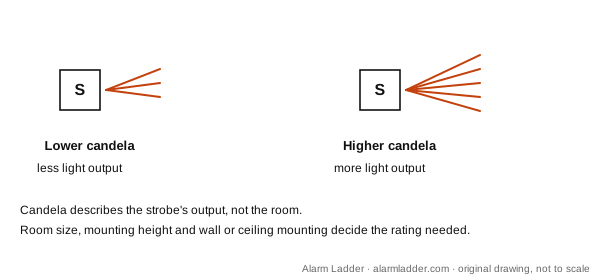
How to use the candela rating
- Start from the room. Measure the room and note the ceiling height and whether the appliance mounts on a wall or ceiling. The tables in NFPA 72 Chapter 18 turn those into a candela choice, so look them up in your own copy.
- Pick the setting on the device. Many strobes have a selector for several candela values. The drawings or the designer's schedule say which one to set, and the setting is recorded in the as-built documents.
- Higher output draws more current. A strobe set to a higher candela uses more current than a lower setting. That current counts in the notification circuit's voltage drop and in the battery calculation.
- Check both in the data sheet. The manufacturer's data gives the current for each setting, and the sizing tools use those figures.
Try one question
Question 1 of the free 10-question check on NICET FA I. No signup. Then ask Strobe, the AI study buddy, why the answer is right and the others are wrong.
Installation
A supplied module drawing labels COM, NO and NC. The door interface needs a switched contact that is open while the relay is at rest and closes when the relay operates. Which pair matches that instruction?
Press A–D or 1–4 to choose an answer while this question is on screen.
Choose an answer to begin
Worked example: why one setting changed the battery
In a fictional corridor, a designer changes a strobe from a lower to a higher candela setting to meet the room table. The strobe now draws more current at alarm. The installer runs the numbers again with the data sheet value and finds the circuit's voltage at the last device is lower than before, and the battery needs more capacity. The setting was a one-click choice on the device. Its effect shows up in two calculations, which is why the number belongs on the schedule and not in a technician's memory.
Ask Strobe before you buy AI your Alarm Ladder study buddy
See what's on the NICET FA I exam, test yourself with 5 quick questions, or find the plan that fits you.
The NICET FA I course
Available now · instant accessLearn every Level I task, then prove it on timed practice exams.
- 6modules of lessonsEvery task on the outline
- 2full-length timed exams85 questions in 110 minutes each
- 340practice questionsEach one explained
- 4worked calculationsStep by step
- 20code-navigation drillsFind it fast in NFPA 72
- 1week-by-week study planSet to your exam date
Turn a practice answer into a study step. In untimed practice, ask Strobe AI about any question you answer, follow up, then see your weakest topics and what to drill next.
Instant access. Terms and refunds · Secure checkout by Stripe
- Level I, II and I&T bundle$299$98 less than buying the 3 courses separatelyIncludes the NICET FA I, NICET FA II and NICET I&T FA courses
Terms and refunds · Secure checkout by Stripe
- Free sample lessonFree
- Question of the dayFree
Every answer comes with a full explanation.
Common mix-ups
- Candela is not coverage area. It is the appliance's output. Coverage comes from the room tables and the listing, so do not compute a distance from a candela number.
- More candela is not always better. Each location has a required value, and a much higher setting wastes current and can be uncomfortable in a small room.
- Wall and ceiling differ. The same strobe is rated and tabled differently by mounting, so check which table applies.
- Candela is not the audible level. Sound is a separate measurement. See temporal-3 pattern for the sound side.
Candela on the NICET Level I exam
Candela shows up in Installation (44 to 54% of Level I), where you set and record it, in layout, where you read the schedule, and in calculations, where it changes current. NFPA 72 (2022) Chapter 18 covers notification appliances and Chapter 10 covers fundamentals including power.
Practice it
See what the current does to a circuit with the fire alarm voltage drop calculator. Read about the NAC circuit that feeds strobes, and the temporal-3 pattern for the audible side. The fire alarm terms glossary lists the rest.
Know your notification terms? Check the rest of Level I
Take the free 10-question check. It's weighted to the Level I outline, scored by domain and needs no signup, so you see whether installation, maintenance or layout costs you the most points. The Level I course gives you full timed practice exams, an explained answer for every question and the section number to look up for each one.
For the sound side of notification, the fire alarm audibility calculator estimates how horn levels change with distance and add together.
Sources
Show the list
- NFPA 72 (2022), NFPA, Chapters 10 and 18, referenced by number only.
- Fire Alarm Systems Level I content outline, NICET.
Facts checked 25 October 2026 against the sources listed above. If something has changed, tell us and we will correct it within 2 business days.
Your next step
Ready to see where you stand on NICET FA I?
Free, untimed and scored by domain. No signup.
Start the free 10-question checkLevel I course. Lessons, timed practice exams and a plan around your exam date. Get Level I course · $99 See the plans or read the free sample lesson.Terms and refunds
Want a timed run? Try the free 25-question mini-mock. The first 5 need no email.