Two-wire vs four-wire smoke detector: fire alarm term explained
A two-wire smoke detector gets its power and sends its alarm signal over the same pair of wires from the panel's zone circuit. A four-wire smoke detector gets power on a separate pair and signals alarm on a second pair. The extra pair changes how the detector is powered, supervised and matched to the panel.
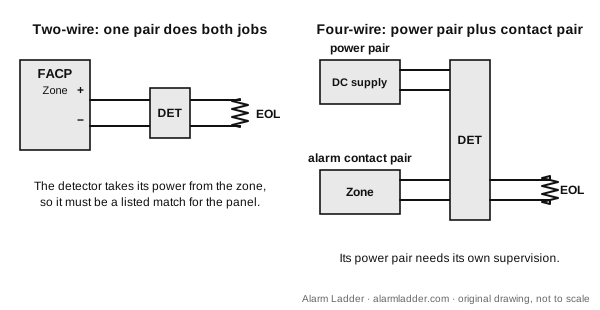
How the two wirings work
- Two-wire. The zone circuit supplies the detector's small operating current and also carries its alarm signal. When the detector alarms, it draws more current or closes a contact, and the panel reads the zone as in alarm.
- Compatibility is the catch. Because the panel's zone powers the detector, the detector and the panel must be listed to work together. The panel's installation manual lists the compatible detectors.
- Four-wire. A separate pair brings power from a power source, at the voltage the detector is listed for, and a second pair is the alarm contact that connects to the zone. The contact pair ends in an end-of-line resistor like any conventional zone.
- Supervising the power. If the four-wire power pair opens, the detector goes dead without the zone seeing anything. A power supervision arrangement, such as a supervisory relay, makes the panel show trouble. The manufacturer's instructions show how.
Try one question
Question 1 of the free 10-question check on NICET FA I. No signup. Then ask Strobe, the AI study buddy, why the answer is right and the others are wrong.
Installation
A supplied module drawing labels COM, NO and NC. The door interface needs a switched contact that is open while the relay is at rest and closes when the relay operates. Which pair matches that instruction?
Press A–D or 1–4 to choose an answer while this question is on screen.
Choose an answer to begin
Worked example: dead detector, quiet panel
In a fictional warehouse, four-wire detectors were wired with a power pair that has no supervision. A cable is cut, and the detectors past the cut lose power. The zone circuit shows normal, because the alarm contact pair is intact. The detectors cannot alarm, and nobody knows. Adding the power supervision, or using a design that supervises the power pair, would have turned the cut into a trouble signal. This is the reason four-wire power gets its own attention.
Ask Strobe before you buy AI your Alarm Ladder study buddy
See what's on the NICET FA I exam, test yourself with 5 quick questions, or find the plan that fits you.
The NICET FA I course
Available now · instant accessLearn every Level I task, then prove it on timed practice exams.
- 6modules of lessonsEvery task on the outline
- 2full-length timed exams85 questions in 110 minutes each
- 340practice questionsEach one explained
- 4worked calculationsStep by step
- 20code-navigation drillsFind it fast in NFPA 72
- 1week-by-week study planSet to your exam date
Turn a practice answer into a study step. In untimed practice, ask Strobe AI about any question you answer, follow up, then see your weakest topics and what to drill next.
Instant access. Terms and refunds · Secure checkout by Stripe
- Level I, II and I&T bundle$299$98 less than buying the 3 courses separatelyIncludes the NICET FA I, NICET FA II and NICET I&T FA courses
Terms and refunds · Secure checkout by Stripe
- Free sample lessonFree
- Question of the dayFree
Every answer comes with a full explanation.
Common mix-ups
- Two-wire does not mean any detector works. The panel and the detector have to be a listed pair.
- Four-wire is not more sensitive. The wiring does not change how the detector senses smoke.
- Two-wire detectors on an addressable loop are a different thing. An addressable detector has two wires to the loop, yet it is not a conventional two-wire detector. See signaling line circuit.
- Four-wire power is not the zone. The power pair is not the alarm circuit, so do not terminate it on zone terminals.
Detector wiring on the NICET Level I exam
Detector wiring sits in Installation (44 to 54% of Level I), where terminals, polarity and end-of-line placement are the tasks, and Maintenance (40 to 50%), where a dead or incompatible detector is a typical fault. NFPA 72 (2022) Chapter 12 covers circuits and pathways and Chapter 17 covers initiating devices.
Practice it
Check cable choice with the fire alarm wire size calculator. Read about the initiating device circuit and the end-of-line resistor that both wirings use. The fire alarm terms glossary lists the rest.
Know your detector wiring? Check the rest of Level I
Take the free 10-question check. It's weighted to the Level I outline, scored by domain and needs no signup, so you see whether installation, maintenance or layout costs you the most points. The Level I course gives you full timed practice exams, an explained answer for every question and the section number to look up for each one.
Sources
Show the list
- NFPA 72 (2022), NFPA, Chapters 12 and 17, referenced by number only.
- Fire Alarm Systems Level I content outline, NICET.
Facts checked 25 October 2026 against the sources listed above. If something has changed, tell us and we will correct it within 2 business days.
Your next step
Ready to see where you stand on NICET FA I?
Free, untimed and scored by domain. No signup.
Start the free 10-question checkLevel I course. Lessons, timed practice exams and a plan around your exam date. Get Level I course · $99 See the plans or read the free sample lesson.Terms and refunds
Want a timed run? Try the free 25-question mini-mock. The first 5 need no email.