End-of-line resistor: what it means on the job
An end-of-line resistor, or EOL, is the resistor installed at the far end of a Class B conventional circuit, such as an initiating device circuit or a notification appliance circuit. The panel sends a small current through the wiring and the resistor. As long as that current stays where expected, the panel knows every foot of wire is intact.
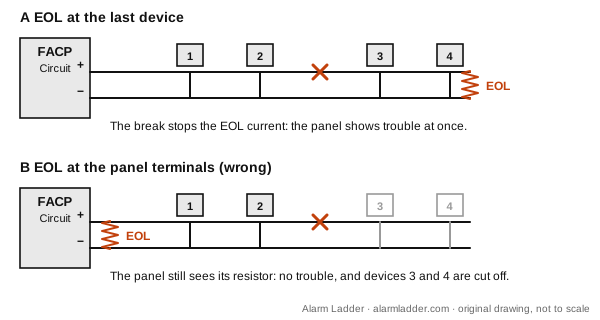
How an EOL resistor works
- It closes the supervision path. In standby the devices on the circuit are open, so without the resistor there would be no path for current at all. The EOL gives the panel a known load at the end of the run.
- An open stops the current. Cut a wire anywhere between the panel and the resistor and the current drops. The panel reports trouble on that circuit.
- The value comes from the manufacturer. The panel is built to expect one resistance, printed in its installation manual. Swapping in a different value changes the current the panel sees, so use the part the manual calls for.
- Placement comes from the manufacturer too. On a Class B run the resistor goes after the last device, often inside the last device's box or on an EOL plate. A Class A circuit returns to the panel, and its manual sets how that return is terminated.
Try one question
Question 1 of the free 10-question check on NICET FA I. No signup. Then ask Strobe, the AI study buddy, why the answer is right and the others are wrong.
Installation
A supplied module drawing labels COM, NO and NC. The door interface needs a switched contact that is open while the relay is at rest and closes when the relay operates. Which pair matches that instruction?
Press A–D or 1–4 to choose an answer while this question is on screen.
Choose an answer to begin
Worked example: why the panel stayed quiet
In a fictional building, a tech finds an EOL resistor landed across a zone's terminals inside the panel, with the field wiring connected beside it. A ceiling contractor later cuts the zone cable halfway along. The panel still sees its resistor, so it stays normal, and every detector past the cut is now disconnected without any warning. Moving the resistor to the last device would have turned that cut into an immediate trouble signal. The drawing above shows both cases.
Ask Strobe before you buy AI your Alarm Ladder study buddy
See what's on the NICET FA I exam, test yourself with 5 quick questions, or find the plan that fits you.
The NICET FA I course
Available now · instant accessLearn every Level I task, then prove it on timed practice exams.
- 6modules of lessonsEvery task on the outline
- 2full-length timed exams85 questions in 110 minutes each
- 340practice questionsEach one explained
- 4worked calculationsStep by step
- 20code-navigation drillsFind it fast in NFPA 72
- 1week-by-week study planSet to your exam date
Turn a practice answer into a study step. In untimed practice, ask Strobe AI about any question you answer, follow up, then see your weakest topics and what to drill next.
Instant access. Terms and refunds · Secure checkout by Stripe
- Level I, II and I&T bundle$299$98 less than buying the 3 courses separatelyIncludes the NICET FA I, NICET FA II and NICET I&T FA courses
Terms and refunds · Secure checkout by Stripe
- Free sample lessonFree
- Question of the dayFree
Every answer comes with a full explanation.
Common mix-ups
- EOL at the panel is not supervision. It makes the panel happy and leaves the field wiring unchecked. If you find one there on a Class B run, treat it as a deficiency to correct, not a shortcut.
- Removing an EOL is not a harmless test. Taking it off opens the supervised path and puts the circuit in trouble. That is useful during a planned test and a problem when nobody told the monitoring station.
- An addressable loop is not supervised by an EOL. A signaling line circuit is supervised by polling the devices. The EOL belongs to conventional circuits such as an initiating device circuit or a NAC.
- EOL is not the class. A Class B circuit uses an EOL at its far end. A Class A circuit comes back to the panel instead, which changes what a single open does. Class A vs Class B wiring shows the difference.
EOL resistors on the NICET Level I exam
EOLs sit across Installation (44 to 54% of Level I), where you land them in the right place, and Maintenance (40 to 50%), where an open or a misplaced resistor is the fault you are chasing. On drawings, EOL is one of the abbreviations you need to read on sight. NFPA 72 (2022) Chapter 12 covers circuits and pathways, and Chapter 14 covers testing.
Practice it
Find the EOL tag among other plan symbols in the fire alarm symbols quiz. See what a cut cable does with the EOL in the right place and the wrong one in the fire alarm circuit class drill. The fire alarm cable types guide covers the cable on these circuits, and NAC vs SLC circuits explains how the EOL supervises a notification circuit in standby.
Know your circuits? Check the rest of Level I
Take the free 10-question check. It's weighted to the Level I outline, scored by domain and needs no signup, so you see whether installation, maintenance or layout costs you the most points. The Level I course gives you full timed practice exams, an explained answer for every question and the section number to look up for each one.
Sources
Show the list
- MS-9200UDLS Series Manual, 52750 Rev M, Fire-Lite, §2.5. Retrieved 17 Oct 2026; Class B termination with an end-of-line resistor.
- NFPA 72 (2022), NFPA, Chapters 12 and 14, referenced by number only. Retrieved 17 Oct 2026.
- Fire Alarm Systems Level I content outline, NICET. Retrieved 17 Oct 2026.
Facts checked 24 October 2026 against the sources listed above. If something has changed, tell us and we will correct it within 2 business days.
Your next step
Ready to see where you stand on NICET FA I?
Free, untimed and scored by domain. No signup.
Start the free 10-question checkLevel I course. Lessons, timed practice exams and a plan around your exam date. Get Level I course · $99 See the plans or read the free sample lesson.Terms and refunds
Want a timed run? Try the free 25-question mini-mock. The first 5 need no email.