FPLP cable: what it means on the job
FPLP is the marking on power-limited fire alarm cable listed for plenum use: F for fire alarm, PL for power-limited and P for plenum. It is the highest of the three power-limited ratings, so it is the cable for spaces used for environmental air, such as a return-air ceiling, and it can stand in for FPLR or FPL.
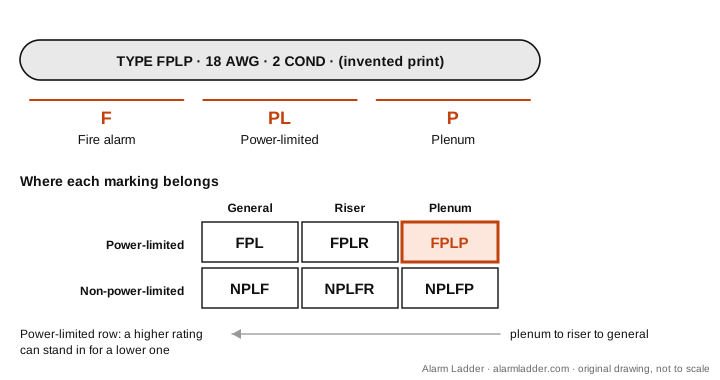
How to read FPLP on a jacket or a cable schedule
- Split the letters. F is fire alarm. PL is power-limited. The last letter is the space rating: P for plenum. If the print reads FPL with nothing after it, that is the general-purpose rating, and FPLR is the riser rating.
- Find the space before the cable. A plenum here means a space that moves environmental air, such as a ceiling used as a return-air path. A suspended ceiling by itself does not make one. The mechanical drawings show whether the space above the tiles carries air, so check them before you order cable for a run.
- Check what it can replace. NFPA 70 (2020) §760.154(A) covers substitution. In plain terms, FPLP can go anywhere FPLR or FPL is called for, and FPLR can go where FPL is called for. It never works the other way: an FPL or FPLR cable does not become plenum cable because the route needs one. Enclosing cable in a raceway is a separate wiring-method lookup under §760.135.
- Read the rest of the print separately. 18/2 means two 18 AWG conductors. Solid or stranded, shielded or not, and the jacket color are separate facts. The plenum letter tells you none of them, and none of them tells you the plenum rating.
- Confirm the circuit is power-limited. FPLP belongs to the power-limited family in Part III of Article 760. A circuit the panel or drawings mark as non-power-limited needs cable from the NPLF family, such as NPLFR, instead.
Try one question
Question 1 of the free 10-question check on NICET FA I. No signup. Then ask Strobe, the AI study buddy, why the answer is right and the others are wrong.
Installation
A supplied module drawing labels COM, NO and NC. The door interface needs a switched contact that is open while the relay is at rest and closes when the relay operates. Which pair matches that instruction?
Press A–D or 1–4 to choose an answer while this question is on screen.
Choose an answer to begin
Common mix-ups
- Plenum and riser are not interchangeable both ways. FPLP in a riser shaft is fine. FPLR above a return-air ceiling is not. When one pull runs through both spaces, the most demanding space on the route sets the rating for the whole cable.
- Plenum rating is not a fire rating for the circuit. FPLP limits how the cable behaves in an air space. It does not keep the circuit working through a fire. Circuit integrity (CI) cable and 2-hour protection are a separate question, covered in NFPA 70 §760.179(G) and NFPA 72 (2022) §12.4.
- Red does not mean FPLP. Belden sells the same 5120FL cable in a red jacket and a blue jacket. Jacket color is a project or product choice, so read the print, not the color.
- A better rating does not fix a size problem. Swapping FPLR for FPLP changes where the cable can run, not how much voltage it loses. Conductor size and length do that.
Ask Strobe before you buy AI your Alarm Ladder study buddy
See what's on the NICET FA I exam, test yourself with 5 quick questions, or find the plan that fits you.
The NICET FA I course
Available now · instant accessLearn every Level I task, then prove it on timed practice exams.
- 6modules of lessonsEvery task on the outline
- 2full-length timed exams85 questions in 110 minutes each
- 340practice questionsEach one explained
- 4worked calculationsStep by step
- 20code-navigation drillsFind it fast in NFPA 72
- 1week-by-week study planSet to your exam date
Turn a practice answer into a study step. In untimed practice, ask Strobe AI about any question you answer, follow up, then see your weakest topics and what to drill next.
Instant access. Terms and refunds · Secure checkout by Stripe
- Level I, II and I&T bundle$299$98 less than buying the 3 courses separatelyIncludes the NICET FA I, NICET FA II and NICET I&T FA courses
Terms and refunds · Secure checkout by Stripe
- Free sample lessonFree
- Question of the dayFree
Every answer comes with a full explanation.
FPLP on the NICET Level I exam
Cable infrastructure sits inside the Installation domain, which NICET weights at 44 to 54% of Level I. NFPA 70 is on screen during the test, so the skill is finding Article 760 quickly and knowing which section answers a substitution or a space question, rather than memorizing it. Expect to decode a marking and match it to a space in the same breath.
Practice it
Once the route has told you the rating, size the conductors for a notification run in the fire alarm wire size calculator; it picks the smallest conductor that holds the voltage at the last appliance, not the listing. The fire alarm cable types guide puts FPL, FPLR, FPLP and the NPLF family side by side with real product sheets, and the NAC vs SLC guide explains why a size that works for horns says nothing about an addressable loop.
Know your cable letters? Check the rest of Level I
Take the free 10-question check. It's weighted to the Level I outline, scored by domain and needs no signup, so you see whether installation, maintenance or layout costs you the most points. The Level I course gives you full timed practice exams, an explained answer for every question and the section number to look up for each one.
Sources
Show the list
- NFPA 70 (2020), NFPA, Article 760, §§760.135, 760.154(A) and 760.179, referenced by number only. Retrieved 17 Oct 2026.
- NFPA 72 (2022), NFPA, §12.4, referenced by number only. Retrieved 17 Oct 2026.
- 5120FL, Belden. Retrieved 17 Oct 2026; jacket color options.
- Fire Alarm Systems Level I content outline, NICET. Retrieved 17 Oct 2026.
Facts checked 24 October 2026 against the sources listed above. If something has changed, tell us and we will correct it within 2 business days.
Your next step
Ready to see where you stand on NICET FA I?
Free, untimed and scored by domain. No signup.
Start the free 10-question checkLevel I course. Lessons, timed practice exams and a plan around your exam date. Get Level I course · $99 See the plans or read the free sample lesson.Terms and refunds
Want a timed run? Try the free 25-question mini-mock. The first 5 need no email.