Ground fault: fire alarm term explained
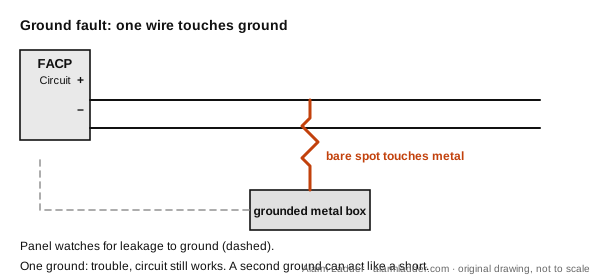
A ground fault happens when a circuit conductor touches ground by accident, such as a bare spot pressed against a metal box or wet conduit. The panel watches for this leakage and shows a trouble signal. One ground usually leaves the circuit working, but a second ground can act like a short.
How to find a ground fault
- Read the text. The panel names a ground fault, and some panels name the circuit. If it names a circuit, begin there. If it only says ground fault, the whole system is suspect.
- Split the system. Disconnect circuits one at a time at the panel terminals, with notice and under the facility's procedure. When the ground fault clears, the circuit you just lifted holds the fault.
- Split the circuit. On the bad circuit, open the wiring at a midpoint and see which half still shows the ground. Keep halving until you reach a short run of cable and a few boxes.
- Look at the usual places. Insulation nicked at a box edge, a conductor pinched by a cover, a shield drain wire touching metal, wet boxes outdoors, and old staples through a cable.
- Repair and confirm. Fix the cause, reconnect the circuits and wait for the panel to clear. Record where the fault was and what you did.
Try one question
Question 1 of the free 10-question check on NICET FA I. No signup. Then ask Strobe, the AI study buddy, why the answer is right and the others are wrong.
Installation
A supplied module drawing labels COM, NO and NC. The door interface needs a switched contact that is open while the relay is at rest and closes when the relay operates. Which pair matches that instruction?
Press A–D or 1–4 to choose an answer while this question is on screen.
Choose an answer to begin
Worked example: halving a loop
A fictional panel shows a ground fault. The tech lifts the notification circuits one by one at the panel and the fault stays. Then the tech lifts the loop, and the fault clears. Going to the middle of the loop and opening it there clears the fault on one side only, so the fault is in that half. Another halving points to a back box in a stairwell where a wire has rubbed against the box edge. Four steps, and the fault is found without testing every device.
Ask Strobe before you buy AI your Alarm Ladder study buddy
See what's on the NICET FA I exam, test yourself with 5 quick questions, or find the plan that fits you.
The NICET FA I course
Available now · instant accessLearn every Level I task, then prove it on timed practice exams.
- 6modules of lessonsEvery task on the outline
- 2full-length timed exams85 questions in 110 minutes each
- 340practice questionsEach one explained
- 4worked calculationsStep by step
- 20code-navigation drillsFind it fast in NFPA 72
- 1week-by-week study planSet to your exam date
Turn a practice answer into a study step. In untimed practice, ask Strobe AI about any question you answer, follow up, then see your weakest topics and what to drill next.
Instant access. Terms and refunds · Secure checkout by Stripe
- Level I, II and I&T bundle$299$98 less than buying the 3 courses separatelyIncludes the NICET FA I, NICET FA II and NICET I&T FA courses
Terms and refunds · Secure checkout by Stripe
- Free sample lessonFree
- Question of the dayFree
Every answer comes with a full explanation.
Common mix-ups
- A ground fault is not an open. An open breaks the path. A ground fault adds an unwanted path to ground, though the circuit may still work.
- One ground is not harmless to ignore. It is the first of two. A second ground on the other conductor can short the circuit through earth and cause failure or false signals.
- Ground detection is a panel feature. Do not tie circuit wiring to ground to make a reading go away.
- The cable shield is not a ground path. Shield drains are terminated as the manufacturer instructs and kept clear of metal boxes, so check how the shield is handled.
Ground faults on the NICET Level I exam
Ground faults are classic Maintenance material (40 to 50% of Level I) and a quality check after Installation (44 to 54%), where careless termination causes them. NFPA 72 (2022) Chapter 12 covers circuits and pathways, Chapter 10 covers fundamentals and Chapter 14 covers testing.
Practice it
The fire alarm circuit class drill lets you work through circuit faults. Read about trouble signals for the wider picture and short-circuit isolators for the related short-circuit case. See the fire alarm terms glossary.
Know your faults? Check the rest of Level I
Take the free 10-question check. It's weighted to the Level I outline, scored by domain and needs no signup, so you see whether installation, maintenance or layout costs you the most points. The Level I course gives you full timed practice exams, an explained answer for every question and the section number to look up for each one.
Sources
Show the list
- NFPA 72 (2022), NFPA, Chapters 10, 12 and 14, referenced by number only.
- Fire Alarm Systems Level I content outline, NICET.
Facts checked 25 October 2026 against the sources listed above. If something has changed, tell us and we will correct it within 2 business days.
Your next step
Ready to see where you stand on NICET FA I?
Free, untimed and scored by domain. No signup.
Start the free 10-question checkLevel I course. Lessons, timed practice exams and a plan around your exam date. Get Level I course · $99 See the plans or read the free sample lesson.Terms and refunds
Want a timed run? Try the free 25-question mini-mock. The first 5 need no email.