Air sampling smoke detection: fire alarm term explained
Air sampling smoke detection, also called aspirating smoke detection, pulls room air through a network of pipes with small sampling holes to one detector unit, which looks for smoke in the combined sample. Because it samples all the time and can report at more than one programmed level, it is chosen where very early warning matters.
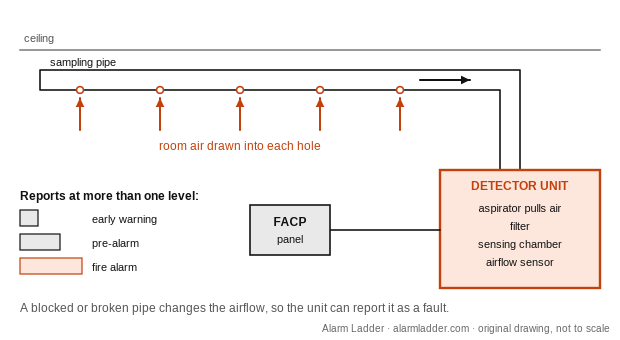
Use this diagram
How an air sampling system works
- Pipes and holes. Pipe runs along the ceiling, over racks or into cabinets, and each small hole is a sampling point. Maker accessories include tamper-proof and flush-mount sampling points for spaces where an open pipe would be in the way.
- The aspirator pulls the air. The unit draws air through every hole, all the time, so the detector sees a blend from the whole pipe run. Smoke entering one hole mixes with clean air from the others, which is why these units are built to sense very small amounts of smoke.
- Filter, then chamber. A filter takes out dust before the air reaches the sensing chamber. The models we checked use a laser-based sensor in that chamber.
- Airflow is measured. The unit watches its own flow. Flow that drops points to blocked holes, and flow that rises points to a broken or loose pipe, and either one is reported as a fault so the pipe is not left blind.
- More than one level. Alarm thresholds are programmable, so an early level can call someone to investigate while a higher level operates the building's fire alarm response. How each level reaches the panel is set by the sequence of operations.
- The hand-off to the panel. The unit reports to the fire alarm control unit through relay outputs or a maker's high-level interface. The panel sees the events it is wired or programmed to see, so check the drawings for which levels and faults are brought in.
Try one question
Question 1 of the free 10-question check on NICET FA IV. No signup. About 14 minutes. Most checks include 2 calculation questions, with a calculator on the page. Then ask Strobe, the AI study assistant, why the answer is right and the others are wrong.
Complex Fire Alarm System Operations
Voice messages in a glass-walled atrium are loud but hard to understand. What design change is most likely to help?
Press A-D or 1-4 to choose an answer while this question is on screen.
Choose an answer to begin
Where you meet it
Maker literature lists places like server rooms, telecom exchanges, control rooms, storage facilities, cabinets and air handling units, and the range runs from small rooms to very large open spaces. The common thread is a space where finding smoke early buys the time to investigate and respond before a fire grows.
Worked example: a kinked pipe in a fictional server room
A fictional server room has one air sampling unit with pipe over the racks. On this job the sequence reports the first level to the panel as a supervisory and only the highest level as a fire alarm. One night the first level comes in. The on-call technician finds a failing power supply giving off a little smoke, and the room is dealt with long before a fire alarm.
A month later a ceiling contractor moves tiles and kinks the pipe. The next morning the unit reports a low airflow fault, and the panel shows a trouble. The technician traces the run, frees the kink and confirms the flow reading has returned to its normal value before clearing the fault.
Common mix-ups
- It is not a duct detector. A duct smoke detector samples air that the HVAC fan is already moving. An air sampling unit makes its own flow through its own pipe network and protects the space, not the duct.
- It is not a spot detector on a long wire. A photoelectric or ionization smoke detector senses at its head. An air sampling system senses at the unit, and the holes only collect air.
- The holes are part of the design. The pipe layout comes from a pre-engineered design or the maker's pipe design software. Adding, moving or taping over a hole changes how the air divides between them, so changes go back to the designer.
- Testing follows the maker. Functional testing introduces test smoke at a sampling point as the manufacturer's instructions describe, and confirms the unit and the panel respond as the sequence says. NFPA 72 (2022) Chapter 14 covers inspection, testing and maintenance.
Air sampling on NICET Level IV and I&T Level II
NICET's Level IV outline names air sampling systems among the complex systems a Level IV technician installs and maintains, and lists resolving complex detection scenarios (4.3.1) inside Complex Fire Alarm System Operations, 40 to 50% of the exam. The NICET Fire Alarm Level IV exam guide covers all three domains.
For Inspection and Testing, the handbook keeps air sampling out of the basic systems Level I covers and names it among the complex systems of Level II. The Level II testing domain, 50 to 60% of that exam, includes testing specialized detection equipment and measuring detector sensitivity.
Ask Strobe: Am I ready?
Ask Strobe before you buy AI your AI study assistant
See what's on the NICET FA IV exam, test yourself with 5 quick questions, or find the plan that fits you.
The NICET FA IV course
Available now · instant accessLearn every Level IV task, from commissioning and budgets to complex detection and voice systems, then prove it on timed practice exams.
Instant access. Terms and refunds · Secure checkout by Stripe · Billed by Nori Software
What's inside
- 10modules of lessonsEvery task on the outline
- 2full-length timed exams120 questions in 290 minutes each
- 351practice questionsEach one explained
- 6worked calculationsStep by step
- 17code-navigation drillsFind it fast in NFPA 72
- 1week-by-week study planSet to your exam date
Turn a practice answer into a study step. In untimed practice, ask Strobe AI about any question you answer, follow up, then see your weakest topics and what to drill next.
Every answer comes with a full explanation.
Practice it
Drill the detector symbols you will see beside it on plans in the fire alarm symbols quiz. Compare how a photoelectric and ionization smoke detector senses at the head, and how a duct smoke detector uses the duct's own airflow. Find the rest in the fire alarm terms glossary.
Know your detection? Take the free 10-question check
Take the free 10-question check for Level IV. It's written to NICET's Level IV outline, needs no signup and explains every answer, so you see which of the three domains to work on first.
Sources
Show the list
- Fire Alarm Systems Level IV content outline, NICET, the complex systems note and task 4.3.1. Checked 14 Nov 2026.
- Inspection and Testing of Fire Alarm Systems candidate handbook, NICET, basic and complex systems and the Level II outline (pp. 12 to 13). Checked 14 Nov 2026.
- VESDA aspirating smoke detection, Xtralis, for continuous sampling, very early warning and multi-level warnings. Checked 14 Nov 2026.
- VESDA VLF product page, Xtralis, for airflow sensing, programmable thresholds, pipe network designs, sampling point and filter accessories, the relay and high-level interfaces and typical spaces. Checked 14 Nov 2026.
- NFPA 72 (2022), NFPA, Chapter 14, referenced by number only. Checked 14 Nov 2026.
Alarm Ladder editorial team
Facts come from the sources listed above. If something has changed, tell us and we will correct it.
Your next step
Ready to see where you stand on NICET FA IV?
Free, untimed and scored by domain. No signup. About 14 minutes. Most checks include 2 calculation questions, with a calculator on the page.
Free 10-question checkLevel IV course. Lessons, timed practice exams and a plan around your exam date.
Get Level IV course · $199Want a timed run? Take the free 25-question practice test (about 60 minutes). No email needed.
Prefer paper? Free printables
- Print a class quiz (free PDF). 10 practice questions with an answer key on page 2.
- Print the flashcards as cut-out cards (free PDF). The free flashcard sample, ready to cut and carry.