Smoke control interface: fire alarm term explained
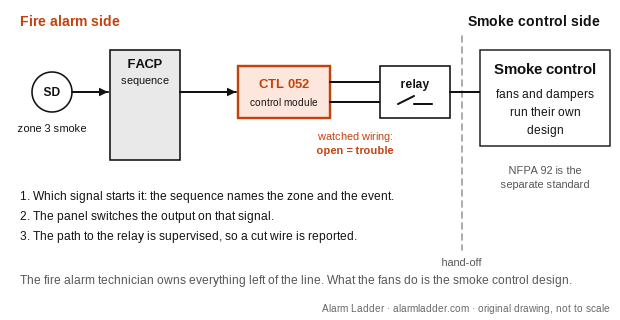
A smoke control interface is the hand-off where the fire alarm system tells a separate smoke control system to start. The fire alarm side decides which alarm signal starts the sequence and switches an output, usually a relay, over a path the panel watches. What the fans and dampers do next belongs to the smoke control design.
Use this diagram
What the fire alarm side owns
- The starting signal. The sequence of operations names which inputs start smoke control and which mode each one starts. Read it as rows: an alarm from a named device or zone on the left, the smoke control mode it calls for on the right. Not every alarm has to start smoke control, so the row is the answer, not your habit.
- The output. The panel switches a control module or relay, the same output idea as a fan shutdown on the monitor module vs control module page. The relay contact is the boundary. The fire alarm technician owns the programming, the module and the wiring to that contact, and the smoke control contractor owns everything past it.
- Supervision of the path. A command that never arrives is the failure to worry about. When the module supervises its output wiring, a cut or shorted wire shows as a trouble at the panel instead of failing silently until the next test. Whether a given module watches its output depends on the model, so the install manual and the drawings tell you what is supervised.
- Status coming back. The fire alarm panel knows it sent the command. It does not know the fan ran unless the design brings a status contact back to a monitor module. When it does, that return is an input, and you test it like one.
Worked example: floor 3 on a fictional office
A fictional four-story office has a smoke control system with one mode per floor. The sequence row for the floor 3 smoke detectors says: start the floor 3 mode. The panel's output for that row is control module CTL 052, and its relay contact lands on the smoke control panel's floor 3 input.
At acceptance, the technician puts a floor 3 detector into alarm, sees CTL 052 operate at the panel and confirms with the controls contractor that their floor 3 input changed state. On this job the module supervises its output wiring, so they lift one conductor between the module and the relay and confirm the panel shows a trouble, then restore it and clear it. The fan and damper results go on the smoke control contractor's test record, checked against their own design.
Try one question
Question 1 of the free 10-question check on NICET FA IV. No signup. About 14 minutes. Most checks include 2 calculation questions, with a calculator on the page. Then ask Strobe, the AI study assistant, why the answer is right and the others are wrong.
Complex Fire Alarm System Operations
Voice messages in a glass-walled atrium are loud but hard to understand. What design change is most likely to help?
Press A-D or 1-4 to choose an answer while this question is on screen.
Choose an answer to begin
Common mix-ups
- HVAC shutdown is not smoke control. Stopping an air handler when a duct smoke detector alarms keeps smoke from being moved around. Smoke control runs fans on purpose to manage smoke, and it is a separate design.
- The fire alarm does not design the smoke control. Fan modes, damper positions and the rest of the system are set by the smoke control design under NFPA 92, a different standard from NFPA 72. Give the fire alarm side its due and stop at the relay.
- A trouble at the interface is your wiring. The fire alarm panel reports the path it watches. A fault inside the smoke control equipment is reported by that system.
- Test both sides together. You prove the command left the panel and arrived at the contact. The other trade proves what their equipment did with it, so book them for the same visit.
Smoke control on NICET Level IV and I&T Level II
NICET's Level IV outline names smoke control interfaces among the complex systems a Level IV technician installs and maintains, and Complex Fire Alarm System Operations is 40 to 50% of the exam. Submittals and layout, 10 to 20%, is where you check that the shop drawings show the interface outputs and the sequence rows that drive them. The NICET Fire Alarm Level IV exam guide covers all three domains.
Inspection and Testing Level II lists inspecting smoke control system interfaces (20 to 30% domain) and testing them (50 to 60% domain). Its reference list adds NFPA 92 (2021) alongside NFPA 72 (2022). The Level IV list does not include NFPA 92; it puts NFPA 72 (2022) and NFPA 70 (2020) on screen, so Level IV interface work is read from NFPA 72, where Chapter 21 covers emergency control function interfaces.
Practice it
Start with the NICET Fire Alarm Level IV exam guide to see where complex interfaces sit. Then review how a control module switches a load and how a duct smoke detector shuts a fan, and find the rest of the vocabulary in the fire alarm terms glossary.
Know your interfaces? Take the free 10-question check
Take the free 10-question check for Level IV. It's written to NICET's Level IV outline, needs no signup and explains every answer, so you see which of the three domains to work on first.
Sources
Show the list
- Fire Alarm Systems Level IV content outline, NICET, the complex systems note and domains 4.2 and 4.3. Checked 14 Nov 2026.
- Inspection and Testing of Fire Alarm Systems candidate handbook, NICET, Level II outline (pp. 12 to 13). Checked 14 Nov 2026.
- ITFAS Level II Selected General References, NICET, for NFPA 72 (2022) and NFPA 92 (2021). Checked 14 Nov 2026.
- Fire Alarm Systems Level IV Selected General References, NICET, for the Level IV reference list. Checked 14 Nov 2026.
- NFPA 92, Standard for Smoke Control Systems, NFPA, scope only; no design values used. Checked 14 Nov 2026.
- NFPA 72 (2022), NFPA, Chapter 21, referenced by number only. Checked 14 Nov 2026.
- Our interface testing post for who owns each side of an interface and how HVAC shutdown differs from smoke control. Checked 14 Nov 2026.
Ask Strobe: Am I ready?
Ask Strobe before you buy AI your AI study assistant
See what's on the NICET FA IV exam, test yourself with 5 quick questions, or find the plan that fits you.
The NICET FA IV course
Available now · instant accessLearn every Level IV task, from commissioning and budgets to complex detection and voice systems, then prove it on timed practice exams.
Instant access. Terms and refunds · Secure checkout by Stripe · Billed by Nori Software
What's inside
- 10modules of lessonsEvery task on the outline
- 2full-length timed exams120 questions in 290 minutes each
- 351practice questionsEach one explained
- 6worked calculationsStep by step
- 17code-navigation drillsFind it fast in NFPA 72
- 1week-by-week study planSet to your exam date
Turn a practice answer into a study step. In untimed practice, ask Strobe AI about any question you answer, follow up, then see your weakest topics and what to drill next.
Every answer comes with a full explanation.
Alarm Ladder editorial team
Facts come from the sources listed above. If something has changed, tell us and we will correct it.
Your next step
Ready to see where you stand on NICET FA IV?
Free, untimed and scored by domain. No signup. About 14 minutes. Most checks include 2 calculation questions, with a calculator on the page.
Free 10-question checkLevel IV course. Lessons, timed practice exams and a plan around your exam date.
Get Level IV course · $199Want a timed run? Take the free 25-question practice test (about 60 minutes). No email needed.
Prefer paper? Free printables
- Print a class quiz (free PDF). 10 practice questions with an answer key on page 2.
- Print the flashcards as cut-out cards (free PDF). The free flashcard sample, ready to cut and carry.