Sequence of operations: fire alarm term explained
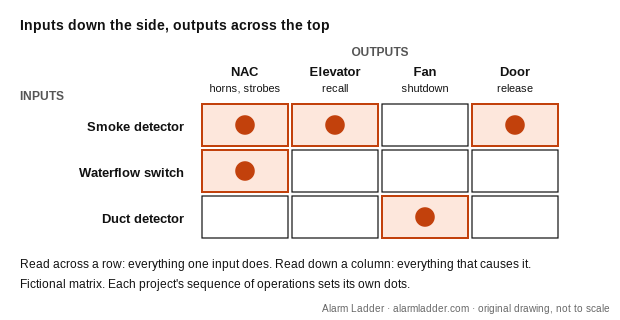
A sequence of operations is the part of a fire alarm submittal that states what the system does for each event. It lists every input, such as a smoke detector, waterflow switch or duct detector, and every output it triggers, such as notification, elevator recall, fan shutdown or door release, usually as an input/output matrix.
Use this diagram
How the matrix is built and read
- Inputs down the side. Each row is one input or a group of alike inputs: smoke detectors by area, a waterflow switch by sprinkler zone, a duct detector by air handler, a valve supervisory switch, a loss of power.
- Outputs across the top. Each column is one action the system takes: sound the notification appliances, send a signal off premises, recall the elevators, shut down a fan, close a damper, release held-open doors.
- A dot at the crossing. A mark where a row meets a column means that input causes that output. An empty cell is a statement too: that input should not cause that output.
- Two ways to read it. Read across a row to see everything one device does. Read down a column to see everything that can start one action, which is how the elevator, HVAC and door trades check their part.
- Where it goes next. The panel programmer builds the program from the matrix, and acceptance testing works through it dot by dot. A copy stays with the record documents for every later test and change.
Worked example: testing one row
A fictional four-story office has a matrix row for the smoke detector in the third-floor elevator lobby. The row has dots under notification, elevator recall and door release, and no dot under fan shutdown. The technician puts test smoke into the detector and checks four things: the horns and strobes sound, the elevators recall, the held-open doors close, and the air handler keeps running because that output is not on the row. If the fan stops, either the program or the matrix is wrong. Settle which one with the designer before acceptance, then retest the row and any row that shares the same output.
Try one question
Question 1 of the free 10-question check on NICET FA IV. No signup. About 14 minutes. Most checks include 2 calculation questions, with a calculator on the page. Then ask Strobe, the AI study assistant, why the answer is right and the others are wrong.
Complex Fire Alarm System Operations
Voice messages in a glass-walled atrium are loud but hard to understand. What design change is most likely to help?
Press A-D or 1-4 to choose an answer while this question is on screen.
Choose an answer to begin
Common mix-ups
- It is not the riser diagram. The riser shows how equipment connects. The sequence shows what happens when something operates. A submittal needs both, and they have to agree.
- The matrix is not the program. The program is supposed to match it, and testing is where a mismatch shows up. Fix the one that is wrong, not whichever is easier.
- Not every row is a fire alarm. A duct detector can report as an alarm on one project and as a supervisory signal on another, so the matrix, not habit, decides.
- A change means a new matrix. Adding devices, moving a fan interface or adding a floor changes rows and columns. Update the sequence and retest the rows it touches.
Sequence of operations on the NICET Level IV exam
NICET's Level IV outline gives submittal preparation and system layout 10 to 20% of the exam, with one task: overseeing the preparation of shop drawings and approving them (4.2.1). Its largest domain, complex fire alarm system operations at 40 to 50%, lists smoke control interfaces among the complex systems. A Level IV technician signs off on the drawings a sequence belongs to, so be ready to judge whether one is complete and agrees with the rest of the package. NFPA 72 (2022) Chapter 7 covers documentation and Chapter 21 covers emergency control function interfaces.
Practice it
Read the submittals and layout guide for the whole package a sequence sits in. See how a control module carries out one output, and why a duct smoke detector exists to stop a fan. A voice evacuation system adds zone-by-zone messages to the matrix. The fire alarm terms glossary lists the rest.
Know your sequences? Check the rest of Level IV
Take the free 10-question check. It is written to NICET's Level IV outline, needs no signup and explains every answer, so you see which of the three domains to work on first.
Sources
Show the list
- Fire Alarm Systems Level IV content outline, NICET, task 4.2.1, domain weights and the complex systems note. Checked 15 Nov 2026.
- NFPA 72 (2022), NFPA, Chapters 7 and 21, referenced by number only. Checked 15 Nov 2026.
Ask Strobe: Am I ready?
Ask Strobe before you buy AI your AI study assistant
See what's on the NICET FA IV exam, test yourself with 5 quick questions, or find the plan that fits you.
The NICET FA IV course
Available now · instant accessLearn every Level IV task, from commissioning and budgets to complex detection and voice systems, then prove it on timed practice exams.
Instant access. Terms and refunds · Secure checkout by Stripe · Billed by Nori Software
What's inside
- 10modules of lessonsEvery task on the outline
- 2full-length timed exams120 questions in 290 minutes each
- 351practice questionsEach one explained
- 6worked calculationsStep by step
- 17code-navigation drillsFind it fast in NFPA 72
- 1week-by-week study planSet to your exam date
Turn a practice answer into a study step. In untimed practice, ask Strobe AI about any question you answer, follow up, then see your weakest topics and what to drill next.
Every answer comes with a full explanation.
Alarm Ladder editorial team
Facts come from the sources listed above. If something has changed, tell us and we will correct it.
Your next step
Ready to see where you stand on NICET FA IV?
Free, untimed and scored by domain. No signup. About 14 minutes. Most checks include 2 calculation questions, with a calculator on the page.
Free 10-question checkLevel IV course. Lessons, timed practice exams and a plan around your exam date.
Get Level IV course · $199Want a timed run? Take the free 25-question practice test (about 60 minutes). No email needed.
Prefer paper? Free printables
- Print a class quiz (free PDF). 10 practice questions with an answer key on page 2.
- Print the flashcards as cut-out cards (free PDF). The free flashcard sample, ready to cut and carry.